Referral and review
Your spine surgeon’s office shares the planned procedure and relevant records with the access-surgery team.

Anterior lumbar spinal access
For an anterior lumbar interbody fusion (ALIF), the access surgeon and spine surgeon work together: one creates and protects the pathway to the spine; the other performs the spinal portion of the operation.
The anatomy
The lumbar spine sits behind the abdominal contents and major blood vessels. Reaching it safely involves more than making an incision.
The access surgeon opens the abdominal wall, enters the appropriate tissue plane, mobilizes the abdominal contents, ureter, and major arteries and veins as needed, and exposes the correct level of the spine. The surgeon then maintains that exposure while the spine surgeon completes the spinal procedure.
At the end of the operation, the access surgeon evaluates the operative field, confirms hemostasis, returns the tissues to their normal position, and closes the approach incision.
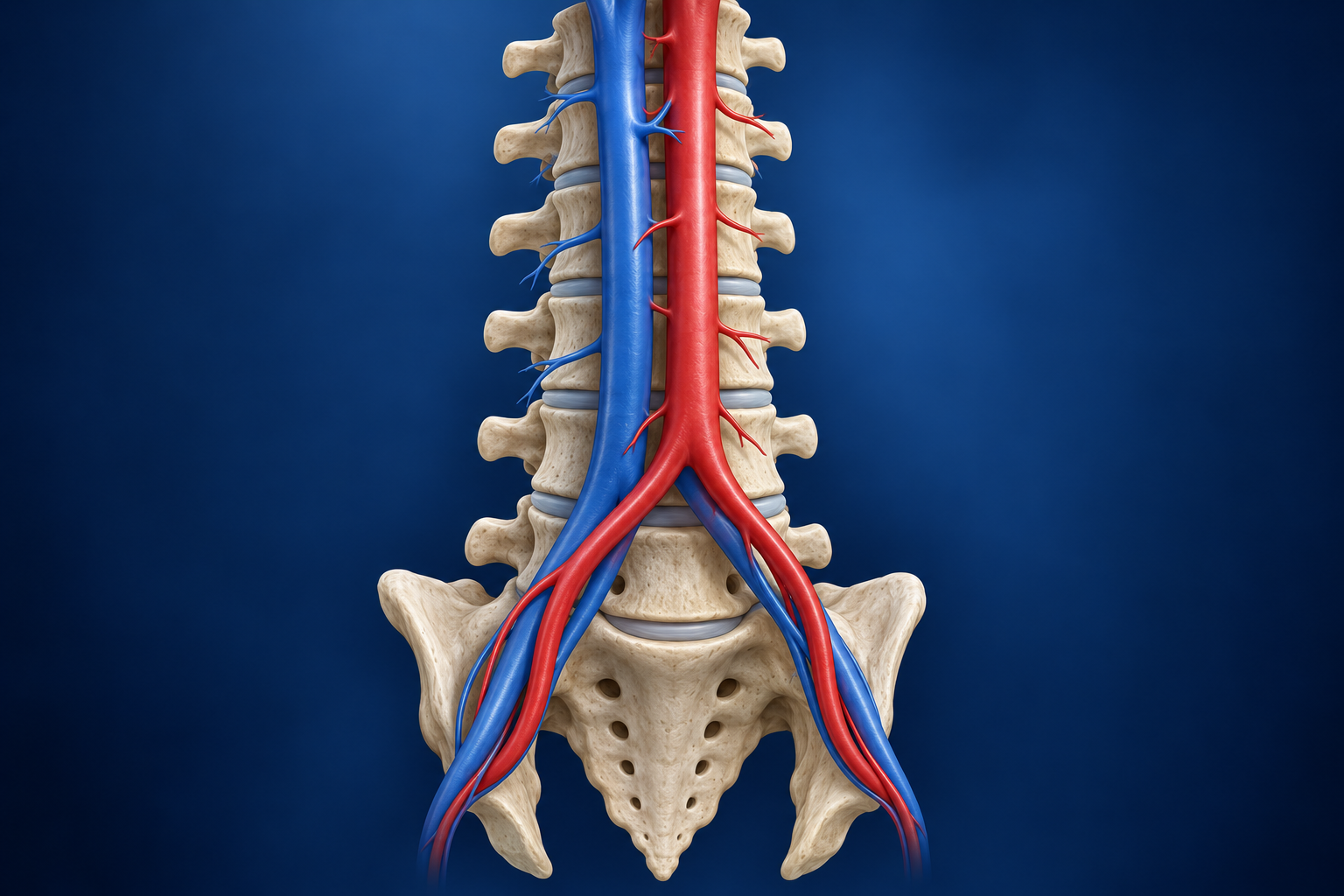
3D anatomy view
The aorta and vena cava—and the iliac vessels formed near the lower lumbar spine—lie directly in front of the operative target.
This illustration is educational and does not represent every patient’s anatomy or operative plan.
The patient pathway
Your exact plan depends on your diagnosis, surgical level, anatomy, medical history, and prior operations. The steps below describe the usual coordination process.
Your spine surgeon’s office shares the planned procedure and relevant records with the access-surgery team.
Your medical and surgical history is reviewed, with particular attention to prior abdominal or pelvic procedures and available imaging.
The access surgeon and spine surgeon perform their respective portions of the operation as one coordinated team.
Potential risks
Every operation has risks, and the risks vary by patient and procedure. Risks related to anterior lumbar exposure may include bleeding or blood-vessel injury, blood clots, infection, injury to nearby organs or the ureter, nerve injury, bowel-function changes, hernia, and sexual or reproductive complications. Additional risks relate to anesthesia and the spinal portion of the operation.
Your surgeons will discuss which risks are most relevant to you, possible alternatives, and the steps taken to reduce risk. A prior abdominal operation does not automatically rule out an anterior approach, but it may change the plan.
The team
Plans and creates the abdominal or retroperitoneal pathway, protects critical structures, and closes the approach.
Determines the indication for surgery and performs the disc, fusion, instrumentation, or other planned spinal work.